
Detour
and drifting around as if in completely separate spaces
The last few months revolved around arrangements for a trip M and I meant to take so we could see The Melancholy Tour. Jbrekkie had announced dates for Japan and South Korea earlier this year, and in our excitement we got tickets to her Tokyo show right away since they sold for relatively cheap. We weren’t sure whether she’d visit other Asian countries anyhow and managed to find good prices on our flight tickets.
Around the same time, the embassy made changes to visa applications. A lot of the information was either incomplete or unclear, an opportunity scalpers took to “assist” people looking to process their papers or book appointments through the new system for exorbitant prices. Waiting for slots to open up felt like being back in university, where just trying to get through the course registration portal was a test both of patience and of luck.
To the uninitiated like us, getting approved for visas seemed like a fraught—but straightforward enough process. The most important things tourists needed to present were (a) a bank certificate with a “high enough” six-month average daily balance and (b) an employment certificate. This was, evidently, a way for them to make sure we didn’t overstay our welcome or live TNT, things that seem disingenuous given the baggage of our history.
Slots for individual appointments came up more regularly and so we booked separate dates to submit our papers, which we completed despite the rush of things. Making things work became a priority since this felt like a long shot that might not come by again in a long time. Arranging the packet reminded me of a previous attempt to apply for a student visa tied to a scholarship that lost its funding—which brought up old wounds—but to my relief my papers got approved.
We’d included a letter in M’s application to explain that for the time being work was in between projects, and that while there were some savings, I would help fund the trip at least in part as a guarantor. Another letter described the nature of our relationship—that I was a “long-time friend” and “travel companion,” complete with photos from high school through university through recent outings with friends and family—to clarify why I was shouldering some of the travel costs. We were hopeful the officers would be more forgiving, and even more so certain that being vague in our language would leave the application less prone to bias. In retrospect it seemed there were other factors beyond us.
M’s passport returned to us marked with red ink over the application stickers, and we took it without speaking. I was asked to sign a log sheet when I retrieved mine a few weeks back, but the person at the counter instead gave us a blank look while their coworkers looked at us with sorry faces, unsure of whether to say anything. Both of us felt spent. M devoted weeks trying to find a place to stay and arranging an itinerary based on things I mentioned I wanted to see or food I wanted to try. We’d pooled most of the spare funds we had trying to make our documents airtight.
Aside from the fact that Jbrekkie was one of our most favorite musicians—and this was the first concert we would attend together—we’d always longed to travel abroad. We’d been fortunate and privileged enough to get to travel, take our days slow every now and then. Getting lost together on trips always made for our fondest memories. That this wasn’t happening for us this time was hard to take. We spent the week contemplating what more we could’ve done—whether we should’ve been more forthcoming in our letters, or if another statement from the bank would’ve made all the difference—but the truth of it was that as long as it wasn’t on paper, M and I had virtually nothing to do with one another in the eyes of this or the other state, and they had no reason to believe I was happy to take responsibility for us both.
With just about a month before the trip M suggested I invite my mother to keep me company. We only really needed those two things but she went out of her way to supply us with an entire statement of assets and liabilities. This gave me the sense she was genuinely excited and shed some hope on the otherwise less promising turn of events. Within a week or so of booking her an appointment, getting everything in order, and taking her papers to the visa center, mother’s application went through without issue. I’d also booked flight tickets for my aunt, who was coming from America to visit for two weeks. She owned a US passport so she didn’t need a visa; they also had a special line at immigration.
At first I thought of this detour possibly as a means to reconnect with my mother, take her to new places since she hadn’t had the chance to do so in a long time. I’d technically moved out since 2017—not counting the college years when we’d spend months apart—and though I’d left some of my things in my room, my grandmother had been using it since her health had been in decline for the last while. I also saw this as a window to talk more about our lives since we only had ourselves. M helped exchange our discount tickets for the first flights to make the most of my aunt’s time, since she was flying back to the Philippines mid-week and then the US the day right after. Mother’s immediate reaction was to point out how expensive it was.
The trip started out decent. We were at the airport before midnight to pass through immigration and board the plane by five in the morning, but (predictably) our takeoff got delayed. Everyone considered this standard for our airlines so we made no complaints, and besides we landed only ten minutes past our original ETA. We took the train from Narita to Asakusa through the Toei SkyAccess line. The ride lasted about an hour, and for most of it we stood huddled together with our luggage. Despite the fact that the train was coming from the airport on a weekday outside of peak season, the coaches were still packed.
As soon as we got off the station, mother’s New Balances, which I recommended she wear on account of all the walking, split apart at the toes. She crouched in a corner to unlock her luggage—which opened up as just one clamshell container with no compartments—and fished out a pair of bright red luxury brand flip flops. I remember wishing to vanish in the moment, but really everyone else was far too busy to even notice. Reading the signs to figure out which platform, what color train to take, or which exit to use took some getting used to, since this often meant the difference between ending up five hundred meters or five kilometers from your point of origin.
It was early afternoon when we checked into the hotel and I plotted a route to Kaminarimon on my phone. Navigating the map proved a little more challenging so I asked the locals around to make sure we were on the right path. It was cold and rainy and we only had the one folding umbrella I’d brought with me. Between this and looking after the elders who needed constant reassurance that we weren’t lost or that they could soon rest their sore feet, things started to feel a little draining. It was a good thing that we’d reached the shopping street, which was busy—and finally after some time—the temple.
The elders stayed behind to take a breather while I foraged for grub: these big things of fried takoyaki filled with equally big things of grilled octopus and vegetables. Despite efforts to convince mother we needed to load up on the plane, we’d gone nearly twelve hours on empty stomachs and forgot ourselves. The three of us devoured the still-steaming tray of food as if in a trance until finally I looked up to find no one else around us was eating. We quickly wrapped everything up and before leaving I went to draw a fortune for a hundred yen using the change I’d received buying takoyaki.
On our way back I trusted mother’s sense of direction to navigate our route, a skill she must’ve left in the homeland as we were once again lost. We were headed nowhere in particular when the rain started to pick back up. Mother made a thing of saying over and over how we were off track and how hungry she felt even though we only took her lead. My aunt, though not as vocal, still egged her on. We were stuck in yet another shopping street and since most of us were tired I led us to a spot packed with locals. They served massive bowls of ramen and though the three of us felt on edge we agreed to order an extra large portion, which came with a clear broth and heaps and heaps of braised pork belly we struggled to get through. My aunt urged me to finish up the rest of it and after settling the bill—with help from the map on my phone—we’d successfully made our way back at last.
It turned out that mother and my aunt had a cousin who lived four stations away from our hotel. They apparently formed a close bond from years of living together at their godmother’s house while they worked in Manila. That evening Cousin B dropped by with her daughter, and learning that we’d booked a tour to view Mount Fuji the following day, she recommended that we rearrange our plans. The rains had rendered the drive to Yamanashi more dangerous and kept it from being visible, anyhow. They also thought this an opportune moment to catch up having not seen each other in close to twenty years.
I spoke with the tour organizer about possibly moving our booking—worried it wasn’t allowed and I’d still get charged the full amount—but they were kind enough about it. At this point it’d already cost a little bit of money to make sure mother and her sister were comfortable and enjoying themselves, even though it became increasingly clear neither of them was really up for exploring the city or spending time together.
Cousin B was teary-eyed the whole night and mother spoke to her in a kind voice I’m not sure I’d ever heard her use.
The next morning we left Asakusa around ten and agreed to check out Shinjuku instead, where I was going to watch the concert another day. It was raining still when we got there, and even though I’d told mother twice that we needed more umbrellas—since she kept mine all to herself instead of at least sharing it with her sister—she brushed it off saying Cousin B would bring spares anyway. This turned out to be a lifesaver since we spent a good few minutes under the rain following the route on Cousin B’s phone, which at the time refused to cooperate.
Not even past halfway through the roundabout walk to the imperial garden mother decided she felt too tired to continue. This so unnerved me, since I’d read online there might still be a few cherry blossoms left, and we were so close to getting there. At first I chalked up my mood to fatigue and sleep deprivation after a whole week of fieldwork, but the truth of it was I didn’t have the capacity for more restraint while the thought crept in that if things were like this as early as now, there was no point to having planned an entire week’s worth of time together. It occurred to me how little it seemed she cared for all of it, including me.
Cousin B implored me for more understanding and we decided to forgo the garden. A break seemed much-needed and we came across a Thai restaurant that served a lunch buffet. This seemed to at least comfort the elders. I’d hoped to try more local food but felt more than grateful we had someplace to take shelter and get warm meals. In the afternoon Cousin B took the group to a few thrift stores so the elders could check out second-hand designer bags. Mother took time choosing between what to buy, and though both her sister and I encouraged her to make a purchase, in the end she decided it was far too excessive. I could only thank the sales assistant for their patience, although it seemed out of pocket to make a comment—no matter how offhand—about Mpox when Cousin B mentioned where we were from.
We took the train home to Asakusa by ourselves since Cousin B worked another job in the evenings and needed to leave at three. Mother again took it upon herself guiding us through which exit we used the first time and we ended up taking the one that led to the temple, which was quite a distance from the hotel. I composed myself and took this instead as a sign to look for snacks. At the line for mitarashi dango—these grilled rice dumpling skewers coated in a thick, shiny, sweet-savory sauce not unlike the one used for fishballs—a group of students put their change together to buy a few sticks. I thought of M, how we’d both wanted to try all sorts of street food together. We’d even made a list: Osaka-style okonomiyaki; sandwiches made with pillowy milk bread, loaded with fluffy cream and fruit; dorayaki, this two-layered pancake stuffed with sweet red bean paste made famous from the show Doraemon.
The elders and I spent the early evening on a drug store and konbini run for food and supplies before returning to the hotel. I’d asked mother if they wanted to have dinner together; she said there was no need as she wasn’t hungry. This was something that happened a lot throughout the week—where I’d ask if she’d like for us to eat together and she’d turn it down because she was already full—without even asking if I’d eaten to begin with.
I remember now when I used to speak with friends about how in our family we rarely waited for each other at meals—let alone shared them—and how they looked at me like I was speaking in a different language.
Not keen on dwelling, I headed up to a sushi place near the hotel that I’d meant for us to try after we’d landed but we never got around to visiting. The restaurant served both an omakase menu and dined guests separately in a boat over the Sumida River. That evening the place was empty, thanks in large part to the erratic weather. I felt so lucky that it seemed as if I’d booked a seating all to myself. Both the chef and their crew were great hosts and we had a lovely chat throughout the service. In fact, his English teacher was from Cebu and he liked Jollibee. I forget the number of dishes but still remember the most sweet-briny spoonful of uni topped with salmon roe, the way fatty tuna melted like butter. After just a few more plates I started to feel the food but thought it was rude to not finish them. A certain pride washed over me as I powered through the entire meal right to dessert, this traditional, crunchy fried dough from back in the Nara period almost 2,000 years ago. The thought struck me—this piece of their culture that dated so far back in history—while we’d lost most of ours.
At first mother meant to come with me to Shinjuku for the concert, but seeing how quickly things tired her I thought it best to spend the next day solo and give ourselves some space. She made plans in no time to check in with my father’s family in Yokohama who’d volunteered to take her sightseeing there. I on the other hand mapped out my excursion first to Shibuya so I could pick up some art supplies for M, and then to Shinjuku where Jbrekkie was performing that night.
We dropped off my aunt at the airport at around six that morning for her flight, and helped her settle in for about two hours. Mother gave her sister a long hug since her next visit would likely not be for another year or so. When we got back to Asakusa I fixed mother up for some coffee and breakfast. I needed to be on my way to make my train, but she’d asked me to fetch water from the lobby as she still couldn’t open our room even though I’d given her the code for it the night before. She asked to practice it, just in case, and still ended up knocking. I managed to leave once I was sure she could get in on her own.
Forgetting the chaos of looking for which line to take and actually boarding the Ginza train, Shibuya Station was frantic. A view of the Scramble greeted passengers as soon as the doors opened and a sea of people rushing to get elsewhere threatened to swallow up clueless tourists such as myself. A kind man and later the date he was waiting for helped me find my way through the station. I took a makeshift stairwell at a construction site surrounding Hachiko Square, where people lined up to get their pictures taken with the monument. Soon I found myself at the crossing with an entire horde hurrying to make videos or pose for photos while the traffic lights blinked all around us.
The omurice spot I’d wanted to try was tucked inside a space hardly bigger than our apartment. I made the rookie mistake getting a more “classic” plate with tomato sauce and grilled pollock roe as opposed to the wagyu patty my seatmate had ordered. The slab of beef was thick and gleamed beneath a pool of rich, dark sauce and instantly I felt myself overcome with envy. Either way I’ll never know what came over me because I do love a good demi-glace. I also quickly learned how most portions were a little more than I was used to. All the while I wondered whether mother managed to make herself something decent for lunch from all the food we’d stocked.
My next stops were quick; I had about a little over an hour before I needed to leave for Shinjuku. At Loft I’d scored a set of watercolor pastels and washi tapes I thought M might want to try along with a small tin of ceremonial-grade matcha. The rain continued throughout the afternoon and I was ever thankful for my parka. Tower Records felt even more overwhelming; all seven of its floors were dedicated to different genres of music. My favorite featured walls and shelves upon shelves lined with vinyl records. I managed to grab a few CDs, including “Charm,” “Stars and Topsoil,” and Shura’s new album “I Got Too Sad For My Friends” (!). This was the last copy and I again felt indebted to all the world for all my luck. Afterwards I passed the time people-watching at a nearby coffee shop through its floor-to-ceiling windows. When I checked on our groupchat mother had shared that she was having a great time in Yokohama. She posed with father’s cousins at their home and sent photos of them playing Jbrekkie music videos on their smart TV.
I arrived at Shinjuku late in the afternoon and waited for people to show up around the venue. The crowd grew and I approached someone I thought I’d seen at the Melancholy listening party from a few months back. It was a huge relief to see a familiar face; we also discovered we shared a common friend, which was surprising. The show would start at seven and ushers soon began escorting us through registration. M and I feared they wouldn’t let me in because the tickets weren’t under my name. I was prepared to explain why I was alone, but at the table they only seemed concerned with the number of people registered under the tickets rather than who booked them. My new friend and I walked through a maze of an entrance and caught a great spot up front fairly close to the stage. The show was sold out and soon enough the entire hall filled with all sorts of people—some of whom looked even older than mother. Michelle came on half past the hour while “Here is Someone” filled the room with soft sounds from the celesta and flute. She moved through the set like a dream and it was unreal and I wished more than anything that M was there with me to see all this.
Since the show wrapped up quickly I somehow got back to Asakusa before mother. It was ten at night and father’s cousins were kind enough to drop her off at the hotel where we briefly said hello. Mother seemed cheerful and even asked how the concert went. When they left she scrolled on her phone in bed until she fell asleep. I can’t remember whether I’d had anything to eat at all that night.
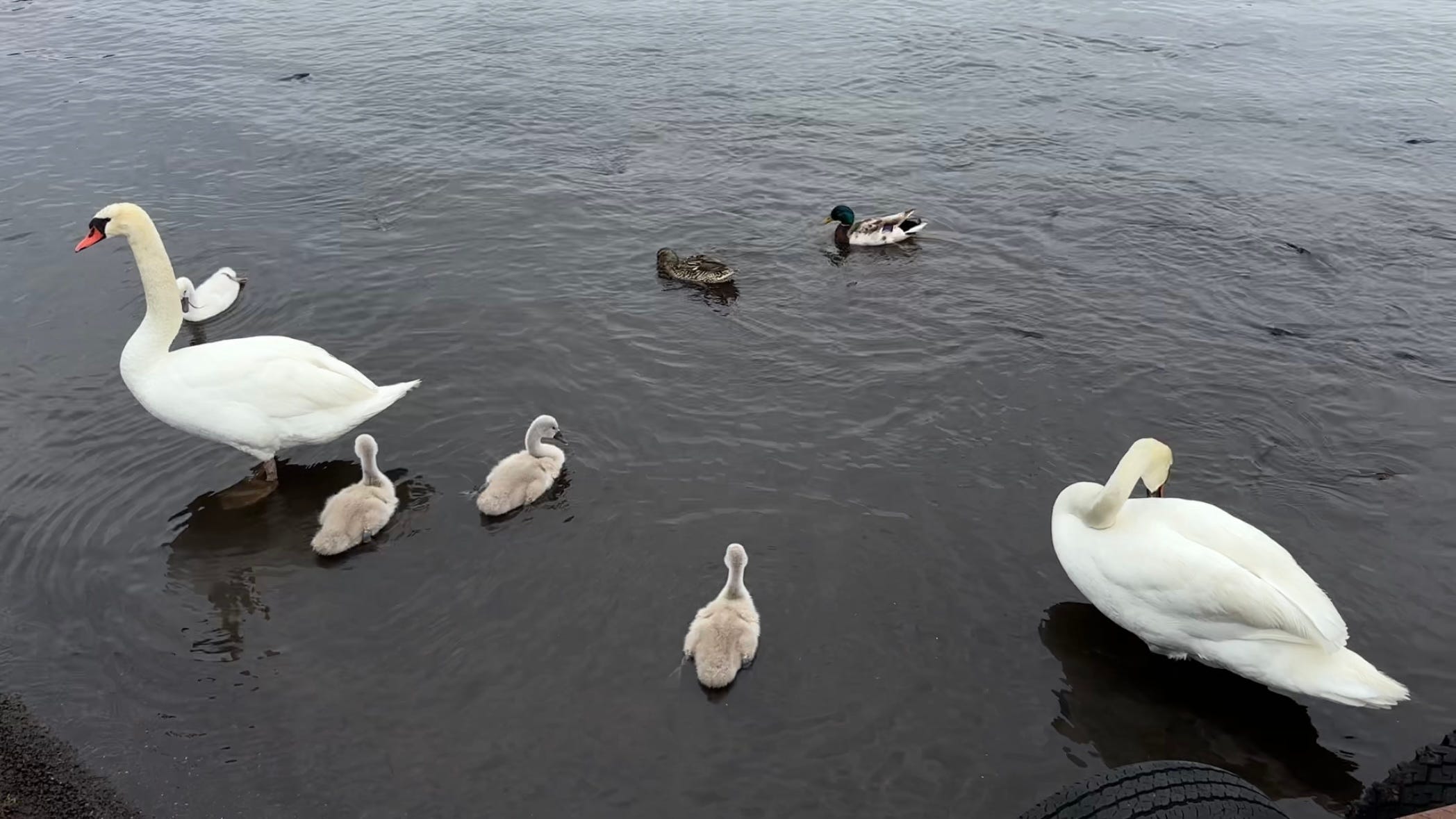
Our Mount Fuji tour that we’d rescheduled for the following day went according to schedule, and though mother refused the long trek up to the viewing deck at the Chureito Pagoda, we made a day of it and I took photos of her at our other stops. I passed an honesty store for pellets at Yamanaka which I used to feed a family of swans by the lakeshore. The mother swooped in as though competing with her cygnets for the food. At our lunch spot I discovered the best iced orange Americano and we shared one dango and one beef skewer in total. Mother had this fear our bus might leave us and so we rushed through the stalls throughout the hour. When we got back to Asakusa I thought it might be nice to spend our last night over dinner but mother said she felt too tired to walk any longer. Instead I came across another local haunt, got myself a small portion of spicy ramen filled with bean sprouts and greens and chashu, and brought her a meal of rice and karaage and a salad.
On our last day I made a quick run to Ginza in the morning for last-minute souvenirs while mother stayed behind in Asakusa. We were at the airport before lunch and with a few snacks in tow waited a few more hours for the check-in counters to open so we could drop off our luggage. A mother and her teenage daughters ahead of us in line talked and laughed among themselves like a group of friends.
When we reached the boarding gates mother mentioned seeing a bottle of designer perfume at the duty-free shop that she hesitated to buy, but I reminded her she still hadn’t picked up anything for herself. She returned giddy, almost like a child. We were almost out of pocket money but I managed to get us some porridge for dinner even though she said she’d had enough to eat. It turned out to be a good thing, since our 7pm takeoff was delayed and did not leave Tokyo until 9, and again I coaxed her into eating on the plane since this was going to be another long flight. We arrived in Manila around midnight. I dropped mother off at their building and hailed a ride from there.
M welcomed me home still groggy from a nap with the cats. We spent the hour talking while I unpacked my suitcase and slept at three in the morning knowing we had to attend a birthday lunch for M’s mother. She liked to make sure we were eating well and left us with a few containers of frozen spring rolls she’d made the night before. I thought of my own mother: there we were, spending days together in a place M and I could only keep dreaming about, drifting around as if in completely separate spaces.